Walford: Hoyland relieved Cruikshank at the guns. Flynn of the 50th came round to see Siggers about going up in an aeroplane during the morning: as they were to go over with the infantry, they wanted to see the coutnry first. He stayed to lunch and talked everyone under the table. Suttie and Bailey went up to the trenches after lunch and it rained all the afternoon. At four, after some tea, I set out for D 36 OP to do liaison officer. I got there soon after five, after having almost throttled myself with wires in Taupin Trench. I had to go down to Bow Street Battalion HQ to see the colonel and it was a rotten trip as the infantry were being relieved, the trenches filthy and you could not see your hand in front of your face. On the way back, the Taupin wires drove me to desperation. I got hung up in them about three times. It was not what one would call a comfortable spot and the rats were very thick.
Colonel Newcombe went home to England to a gunnery school. He is to be an instructer under Brigadier Kerwin who is OC school.
Bee: Slept at the guns last night. Shooting all night. The tanks were supported to come up. But it started raining about eight p.m. and they must have had to stop where they were. Colonel Newcombe left us today. He has been taken home to start a new school of instruction for OC during the winter. He and our late Colonel General Kerwin, the two best and most thorough men I have met out here. They are both awfully nice men personally as well. A brute of a day. It rained all night and all of today. Show has been put off 48 hours now this jolly wet has started, of course. I have not a pair of boots to my name that are watertight. Have been waiting until I go on leave but have been caught on the hop all right.
Monday, 24 October 2011

Sunday, 23 October 2011
Diary Entry - 23rd October, 1916
Walford: Relieved by Cruikshank at ten a.m and hear that Siggers has been appointed intelligence officer for the brigade and has to go over with the infantry. Good luck to him. In the afternoon, Siggers and I had a tour of the big uns, first of all visiting 15-inch howitzer - she is called granny and was firing when we arrived. She is not a big piece, but the shells are huge and stand about 3.6 height, weighing 11 cwt. What sort of a splash it makes on landing, I shudder to think. The 12-inch howitzer was our next stop. It is a nice looking piece and a much solider looking weapon. The shell it fires is large too, it weighs 7 cwt. We passed numerous 9.2 and 6-inch hows between the two large ones. The former having an enormous dump of ammunition at their guns. We also had a squint at the 6-inch Mark VII, which was firing as we passed. The officers of the 12-inch were very hospitable, showed us all over the gun then gave us a drink at the Mess, which was on the side of a railway embankment.
In the evening the captain on returning from brigade informed me I had been awarded the Military Cross.
Bee: Went up to the guns this morning, a very foggy morning but much warmer and the fog lifted for an hour about two p.m. But got very little shooting done. The Hun aeroplanes were fairly active during this time. The show was put off again. I don't think it will ever take place. And am certain that we always let the Hun know long beforehand that we intend to make a push by the artillery all shooting like fun a week beforehand.
In the evening the captain on returning from brigade informed me I had been awarded the Military Cross.
Bee: Went up to the guns this morning, a very foggy morning but much warmer and the fog lifted for an hour about two p.m. But got very little shooting done. The Hun aeroplanes were fairly active during this time. The show was put off again. I don't think it will ever take place. And am certain that we always let the Hun know long beforehand that we intend to make a push by the artillery all shooting like fun a week beforehand.
Saturday, 22 October 2011
Diary Entry - 22nd October, 1916
Walford: Sunday. More frost and another cold east wind blowing. I relieved Cruikshank at the guns. Bailley, who had come up from the wagon line for breakfast walked up with Suttie and myself. We shot the whole day, loosing off 1089 rounds at the Bosche. Nothing thrilling happened.
Bee: Another fearfully raw day. Wrote most of the morning. After lunch went on to D 26 to hear what news I could get out of Sanger, as he has just returned from leave. Heard about Uncle and Spud Ritchie, who were wounded on the Somme. I went up into the hedge in front of their battery to see if I could see Stuff Redoubt, but it was too misty. It was the first time I had watched a 4.5 fire and I was surprised to see how far you could follow the shell in the air. After afternoon tea we came back and visited Kellagher, who is moving up into his new position 1,000 yards from the front line. A very unhealthy spot, I think.
Bee: Another fearfully raw day. Wrote most of the morning. After lunch went on to D 26 to hear what news I could get out of Sanger, as he has just returned from leave. Heard about Uncle and Spud Ritchie, who were wounded on the Somme. I went up into the hedge in front of their battery to see if I could see Stuff Redoubt, but it was too misty. It was the first time I had watched a 4.5 fire and I was surprised to see how far you could follow the shell in the air. After afternoon tea we came back and visited Kellagher, who is moving up into his new position 1,000 yards from the front line. A very unhealthy spot, I think.
Friday, 21 October 2011
Diary Entry - 21st October, 1916
Walford: Saturday. Cruikshank relieved me at eleven a.m. Luckily Bee had shared his breakfast with me, or I should have been left without any. As my horses were waiting for me on the Succerie side of the dressing station, Bee and I rode down together and my groom walked. In the afternoon, we rode over to Acheux, passing through Headeauville on the way. Siggers was coming with us, but had to go up to the trenches as Liaison officer. We came back by the wagon lines, which were in a state of bog, picked up Claudie there and rode back across country, passing a lot of 6-inch hows and 9.2 hows, a battery of the former being concealed as hay stacks.
Bee: A white frost last night, very cold, but the sun was out most of the day. Every was late coming up to the guns as they were out late last night, carting ammunition, but did not know that they were not coming up until late. So I pushed off about ten thirty a.m and had some breakfast with Walford at eleven a.m. Walford and I were at the guns last night. After lunch, we rode round to Acheux and visited the field cashier. The country back there is alive with troops and the roads are alive with traffic
Bee: A white frost last night, very cold, but the sun was out most of the day. Every was late coming up to the guns as they were out late last night, carting ammunition, but did not know that they were not coming up until late. So I pushed off about ten thirty a.m and had some breakfast with Walford at eleven a.m. Walford and I were at the guns last night. After lunch, we rode round to Acheux and visited the field cashier. The country back there is alive with troops and the roads are alive with traffic
Thursday, 20 October 2011
Diary Entry - 20th October, 1916
Walford: Friday. Instead of going up to the guns the previous evening, I relieved Siggers at ten a.m. He in turn had relieved Cruikshank. Siggers had spent a night as liaison officer in D36 OP. The night had been very frosty and there was a bitter east wind blowing. We fired 800 rounds on the wire in the course of the afternoon. The Bosche had been busy with his pipsqueaks at midday and caught three men of the 15th, one seriously and the others - two sergeants - only slight wounds. If the 15th had not tried to get the man away when they were still shelling, as any sensible people should have done, only one man would have suffered.
Bee: Very cold day, east wind, up at the guns all day, did a lot of shooting. The Hun got some lucky ones in on us with [illegible] Sergeant Parrish and a gunner. The former was rather badly wounded - went into his back and must have touched his lungs. As they were carrying him away, Sergeant Villa was hit, but only slightly. It all happened inside five minutes. He put a good many pipsqueaks over and had a good line [illegible], but it was only chance.
Bee: Very cold day, east wind, up at the guns all day, did a lot of shooting. The Hun got some lucky ones in on us with [illegible] Sergeant Parrish and a gunner. The former was rather badly wounded - went into his back and must have touched his lungs. As they were carrying him away, Sergeant Villa was hit, but only slightly. It all happened inside five minutes. He put a good many pipsqueaks over and had a good line [illegible], but it was only chance.
Wednesday, 19 October 2011
Diary Entry - 19th October, 1916
Walford: Thursday, the day having been fine, you could only expect it to rain that night, and it did do, very heavily, continuing through the day. I read in the Mess all morning and after lunch looked the signallers up in their billet and also walked over to D36 to see Sanger, who was away. They have a good position along a line of trees but their dugouts were all leaking after the heavy rain. Some of them looked like underground tanks.
Bee: Woke up with the rain dripping through onto my bed. It is a good summer house but the roof will have to be patched
Bee: Woke up with the rain dripping through onto my bed. It is a good summer house but the roof will have to be patched
Monday, 17 October 2011
Diary Entry - 18th October, 1916
Walford: Wednesday, at the guns all day, superintended work on the position during the morning and the Captain, after lunching with me, cut wire all the afternoon. Bosche during the morning had thrown over a good many 8-inch very indiscriminately but the closest had fallen at the Euston crossroads. However, in the afternoon, as an aeroplane had approached unobserved to the 15th and seen them firing, the 8-inch was turned on to them. This made it very uncomfortable for us as the batteries were only about 30 yards apart. The 15th while firing had one direct hit on a pit but the one man inside emerged unscathed. Several landed on our side of the tram line rather close and so we evacuated for about 15 minutes to see what they would do. The 15th had also evacuated. Bosch however chucked it and we came back and went to gun fire first with the right section then right half battery finally the whole battery and fairly hurled the shells over, firing 800 for the afternoon, which, of course, ends at four forty-five now, on account of the light.
Bee: Damned cold last night, but I had nothing to complain of as I had my blankets and a bed, but the signallers found it very cold as one was on duty all night. The dugout has two entrances but is nothing extra. Kellagher built the OP which is a very fine structure. It is built of bricks which they carried from the Sugar Factory and has steel girders and a concrete roof, but it rained hard last night and the roof leaked like fun. I got out about six, mainly because I was cold, thinking I might get a shot at the Hun but it was such a rotten light I did not see much. The OP became a very popular place for OS who were cutting wire. The 34th Brigade's Colonel Parry came along and was rather on heat re being in view of his battery op, but I think he is rather selfish. Anyway, he must have gone back and seen our colonel as we had to shift to another op that night. I hardly got a look at the front at all between ten a.m. and four p.m. Major Jones and Captain Grant Suttie and a few others occupied the loop hole.
Bee: Damned cold last night, but I had nothing to complain of as I had my blankets and a bed, but the signallers found it very cold as one was on duty all night. The dugout has two entrances but is nothing extra. Kellagher built the OP which is a very fine structure. It is built of bricks which they carried from the Sugar Factory and has steel girders and a concrete roof, but it rained hard last night and the roof leaked like fun. I got out about six, mainly because I was cold, thinking I might get a shot at the Hun but it was such a rotten light I did not see much. The OP became a very popular place for OS who were cutting wire. The 34th Brigade's Colonel Parry came along and was rather on heat re being in view of his battery op, but I think he is rather selfish. Anyway, he must have gone back and seen our colonel as we had to shift to another op that night. I hardly got a look at the front at all between ten a.m. and four p.m. Major Jones and Captain Grant Suttie and a few others occupied the loop hole.
Diary Entry - 17th October, 1916
Walford: Tuesday, I took it easy all day. It rained in the afternoon and continued all night. For some reason or other after lunch Br. Gordon and Soeul, my servant, took it into their heads to have a drink. Where they got it, I don't know. However they took too much and were so incapable that I had to leave the Mess so as I would not have to arrest anyone. After dinner, at seven, I set out for the guns, walking in front of the cook's cart to guide it. I call it walking, but it was more like wading through a mire of mud. Cruikshank was relieved and had to walk back and that evening it occurred to me that a relief in daylight would be a better idea.
Bee: Went to the 48th for lunch and found Siggers and Walrond there. They were very excited as they thought I had come to tell them I was going on leave. I then went up to have a look at the front from the 56th OP as we do liaison officer from there. Then came back had tea and started after tea for my 24 hours. There was a nasty sight in Roman Road Trench. Some infantry had evidently been hit and bits were all over the place.
Bee: Went to the 48th for lunch and found Siggers and Walrond there. They were very excited as they thought I had come to tell them I was going on leave. I then went up to have a look at the front from the 56th OP as we do liaison officer from there. Then came back had tea and started after tea for my 24 hours. There was a nasty sight in Roman Road Trench. Some infantry had evidently been hit and bits were all over the place.
Sunday, 16 October 2011
Diary Entry - 16th October, 1916
Walford: Monday, I remained at the OP all day. It was a well-built place of bricks, girders and concrete, but just like an icebox, as it was very draughty. The General and Carrington came round for half an hour in the morning, which put the wind up me as I did not know the front well, not having seen it before. Kellagher and Suttie also came up in the course of the afternoon, and I was relieved by Dean of the 71s at six.
Bee: A glorious day. I had to go and sit at the Brigade this afternoon as all of them had to go out. Had a very slack day on the whole. Then went to dinner there in the evening. The Colonel is very fed up as they are talking of sending him home to take charge of a new training school which is just being started. The Hun put a few 8-inch over into the village during the afternoon. One fell not very far from our Mess and one hit a house that we intended to live in.
Bee: A glorious day. I had to go and sit at the Brigade this afternoon as all of them had to go out. Had a very slack day on the whole. Then went to dinner there in the evening. The Colonel is very fed up as they are talking of sending him home to take charge of a new training school which is just being started. The Hun put a few 8-inch over into the village during the afternoon. One fell not very far from our Mess and one hit a house that we intended to live in.
Diary Entry - 15th October, 1916
Walford: Sunday, it was my day off. As Siggers had returned from the wagon line Hoyland was to go down but he remained here till about three. He made a nuisance of himself in the morning and in the afternoon we went round to the 15th Mess but no-one was in. I was to do liaison officer that night so had dinner at six forty-five and reached Kellagher's OP at eight p.m., where I could not find McIntyre, whom I was to relieve. However, he returned from the Left Battalion HQ about nine.
Bee: Up at the guns all day. Hun aeroplanes were very active but were kept behind Hun lines. Ward came through at two p.m. saying that we had to shift our position, so Walrond let the men break off. It was not until eight p.m. that this order was counterordered. It was all very rich when we heard we had to shift after working for so long. There was a heavy straff by the Huns last night, with mortars, and the infantry ran up for retaliation. The adj., being a bit of a sport, thought that he did not get enough support, and so he ran up an SOS rocket, a very valuable thing, there being only 20 in the Corps. It had the desired effect and started the heavies and everyone going, but I would not care to be in the adj's shoes this morning.
Bee: Up at the guns all day. Hun aeroplanes were very active but were kept behind Hun lines. Ward came through at two p.m. saying that we had to shift our position, so Walrond let the men break off. It was not until eight p.m. that this order was counterordered. It was all very rich when we heard we had to shift after working for so long. There was a heavy straff by the Huns last night, with mortars, and the infantry ran up for retaliation. The adj., being a bit of a sport, thought that he did not get enough support, and so he ran up an SOS rocket, a very valuable thing, there being only 20 in the Corps. It had the desired effect and started the heavies and everyone going, but I would not care to be in the adj's shoes this morning.
Friday, 14 October 2011
Diary Entry - 14th October, 1916
Walford: Another cold day spent at the Maillet position. Bailley and Siggers turned up about six and stopped for an hour. Then, about eight, they phoned me to come in, so I set out for the Mess without waiting for my relief. As it was the anniversary of the Captain's command of the battery, we had a dinner. Kellagher was there, as also was Bailley. All went well - in fact, almost too well with the latter - he gave us an amusing speech in which he contradicted himself about ten times. The after effects about bed time were also rather bad.
Bee: Today and yesterday, nothing much doing, just kept digging, but can't get any information as to when the show is coming off.
Bee: Today and yesterday, nothing much doing, just kept digging, but can't get any information as to when the show is coming off.
Thursday, 13 October 2011
Diary Entry - 13th October, 1916
Walford: Friday, Hoyland was at the M position, Cruikshank at the Mess, myself at the guns. In the afternoon, Suttie fired 335 rounds and fairly stirred the Bosche up. He was cutting wire and got the first 100 rounds off in about 15 minutes and 200 in 45 minutes. We went to five rounds gunfire after battery fire as fast as was convenient, laying each round carefully. Well, Boschie's counter battery got annoyed and put about 40 rounds on the positions round the Succerie, whereupon we stopped till he had finished, solemnly starting again and going to another 5 rounds gunfire. This stirred Bosche to anger again, and he put over about another 50 4.2s and 5.9s and, as we stopped again, I think he thought he had us marked down.
Wednesday, 12 October 2011
Diary Entry - 12th October, 1916
Walford: Hoyland was at the guns, Cruikshank at the Maillet position and I was at the Mess. For most of the morning I wrote letters and in the afternoon I strolled along to Kellagher's battery for a bath. After having rather a struggle with the Wedgwood, I got a good wash and went into the Mess for tea, where K, Medge, Wailley and McIntyre were already seated. Their Mess was so comfortable that I did not like turning out to go back in the cold.
Bee: Went up to the forward position today. About ten a.m. the rest of the officers came up and said there was going to be straff and that we had to cut the first line wire. So, of course, there was great heat as the day before we were cut down to 100 rounds a day. It finally turned out to be a feint attack to find out how much artillery the Hun had against us. And it was found that he had very little he could put onto this particular front.
Bee: Went up to the forward position today. About ten a.m. the rest of the officers came up and said there was going to be straff and that we had to cut the first line wire. So, of course, there was great heat as the day before we were cut down to 100 rounds a day. It finally turned out to be a feint attack to find out how much artillery the Hun had against us. And it was found that he had very little he could put onto this particular front.
Diary Entry - 11th October, 1916
Walford: A very dull cold day, spent at the Maillet position. The OC came down in the morning and had a look through the signalling equipment and moved it into our dugout as it was so damp where it was. After having made a hole in the roof to let smoke out, I got a fire going in a tin and dried all the instruments and signalling equipment, which needed it badly. Cruickshank relieved me.
Bee: More rain this morning. I went to the wagon line, which is at Bus, but I went by Acheux, where the field cashier is. The country seems to be alive with infantry and transport. The wagon line has shifted a few yards but is still on a ploughed field. I came back by Courcelles. I saw a covey of 9.2-inch very cleverly concealed. There are a lot of haystacks and one battery has built haystacks for gun pits, which are very well disguised. No one could possibly see they were guns until five yards away. I was at the 56th battery yesterday. Kellagher has a wonderful show. I don't think I have seen a position more complete - electric bells and speaking tube to each pit. And he has just completed a reinforced concrete pit, which was built inside one of his ordinary pits and would be proof against most things. He also has a hot and cold water bath laid on, which is luxurious.
Bee: More rain this morning. I went to the wagon line, which is at Bus, but I went by Acheux, where the field cashier is. The country seems to be alive with infantry and transport. The wagon line has shifted a few yards but is still on a ploughed field. I came back by Courcelles. I saw a covey of 9.2-inch very cleverly concealed. There are a lot of haystacks and one battery has built haystacks for gun pits, which are very well disguised. No one could possibly see they were guns until five yards away. I was at the 56th battery yesterday. Kellagher has a wonderful show. I don't think I have seen a position more complete - electric bells and speaking tube to each pit. And he has just completed a reinforced concrete pit, which was built inside one of his ordinary pits and would be proof against most things. He also has a hot and cold water bath laid on, which is luxurious.
Monday, 10 October 2011
Diary Entry -10th October, 1916
Walford: A splendid summer day. The Captain and self went to the wirecutting guns. Hoyland remained at the Mess to bury Br. Spencer and also to get a billet from the town Mayor in Maillet. I laid out the lines of No. 4 gun but at first attempt read off the wrong angle, which caused a lot of heat. I am not used to the No. 3 director and it has a bad zero mark. We eventually got going but when 95 rounds were fired the brigade asked us to stop as only 400 rounds were allotted to our brigade and we were to fire high explosive. In the afternoon, we made the total up to 341 and stopped. We got a lot of work put in at the position and I dug quite a nice hole in the ammunition pit during the time there was no firing. Siggers went off to the wagon line that night, Cruikshank having come up. Kellagher dined with us and it was quite like old times again.
Bee: A beautiful day, bright sunshine. Went up to the OP to carry on the wire cutting, as Walrond had to go to the frontline with the colonel. But had only fired 30 rounds when a message came through to say to cut down our expenditure to 400 rounds per Brigade, which looks as if the show will be put off. Up until yesterday, we were to shoot as much as possible and we got rid of 900 rounds from four guns. Saw Walford today and heard about his effort at Stuff Redoubt, which he was recommended for. Then came back to the Brigade for afternoon tea.
Bee: A beautiful day, bright sunshine. Went up to the OP to carry on the wire cutting, as Walrond had to go to the frontline with the colonel. But had only fired 30 rounds when a message came through to say to cut down our expenditure to 400 rounds per Brigade, which looks as if the show will be put off. Up until yesterday, we were to shoot as much as possible and we got rid of 900 rounds from four guns. Saw Walford today and heard about his effort at Stuff Redoubt, which he was recommended for. Then came back to the Brigade for afternoon tea.
Diary Entry - 9th October, 1916
Walford: The Captain, Siggers and self went to the gun position in front of Euston Dump. Hoyland remained in the mess. The Captain took Siggers up to the OP with him to cut wire but, as it was overcrowded, Siggers returned to the battery and we worked on the combined 15th and 48th Mess there. We fired 600 rounds with the three guns.
Bee: I had a day off. I spent the morning sorting out papers that I had accumulated since we were here last. It was much finer today and looks as if we might get decent weather now. Walford, I see by orders, has had his name sent in for a decoration by the 11th Division for something he did while doing liaison officer at Stuff Redoubt. I have not seen him since we left here before. I went round to the 48th in the afternoon, but only found Hoyland in.
Bee: I had a day off. I spent the morning sorting out papers that I had accumulated since we were here last. It was much finer today and looks as if we might get decent weather now. Walford, I see by orders, has had his name sent in for a decoration by the 11th Division for something he did while doing liaison officer at Stuff Redoubt. I have not seen him since we left here before. I went round to the 48th in the afternoon, but only found Hoyland in.
Saturday, 8 October 2011
Diary Entry - 8th October, 1916
Walford: I came to the guns, arriving there at nine forty five a.m. and I stopped at the Mess all day, to answer any telephone messages or orders that might come in. It rained hard all morning and I was not sorry to be undercover, except that it was darned cold sitting in a big draughty 60-pounder gun pit with no fire and the rain dripping through the roof. All the other officers were at the main wire cutting position in front of the Succerie. They returned at dusk. About seven, it was reported by the NCO in charge of supplies that Br. Spencer, our orderly to brigade, had been found dead on the road, one of the 4.2 we had heard bursting on the outskirts of Mailly Maillet must have got him. He had been riding a bicycle when the shell struck him and the front wheel had a piece blown clean out of it. Our luck seems to have deserted us.
Bee: It has been a brute of a day. It rained hard this morning and we were wet before we got to the position. It was rather a tiring day running about all the time, watching the different parties. You are really a foreman. They shelled our old position with 8-inch armour piercing, like yesterday, and gave us a few splinters. Walrond started cutting wire, which kept us going all the afternoon. There are dozens of guns coming in here every day. Heavies are as thick as flies. I expect there will be some show here shortly. Rumours says this is the biggest concentration of artillery there has been yet.
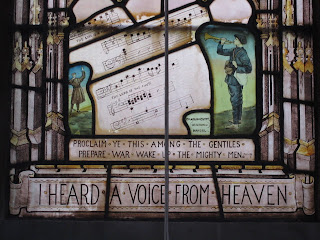
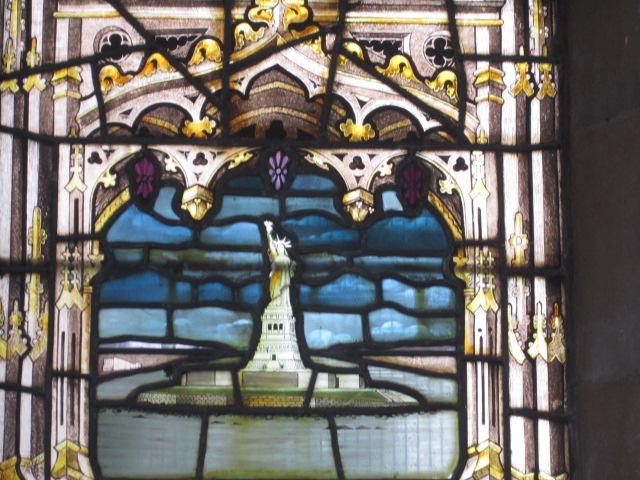
Stained Glass Windows Commemorating World War One
These windows in St Mary's Church at Swaffham Prior show scenes from World War One, including a tank almost identical to that drawn by Bee - sadly, the light shone from behind it and it did not emerge clearly in the photograph I took:




Friday, 7 October 2011
Diary Entry - 7th October, 1916
Walford: Saturday, it was raining when I woke and continued very heavily until about eleven. Bailley went up to the guns for breakfast and remained there until about four p.m. I was at the lines most of the day and collected 600 rounds from the DAC and sent off two GS wagons to collect RE material from our old position, which by some stroke of good luck was still there having laid there since we were at Thiepval. Hoyland moved up to the guns at ten a.m. At four p.m I went over to Louvencourt to see if I could get some butter but had no luck. The infantry had been practising attacks on the country surrounding the wagon lines and had the trenches marked out with canvas to represent the enemy's lines. They did the whole show in pukka style, having men with flags to represent the barrage lighting flares when their objectives were gained and having an aeroplane in cooperation.
Bee: Went up to our new position with a working party. The Brigade are all close together and are all digging pits. We have four old positions just behind us for billets. I was up there all day. The positions were not decided on until eleven p.m. We started building three pits. Our gun pit billets are full of trench mortar bombs, which took us three hours to shift. About six p.m. a Colonel from the 3rd Division came along and told me that we had better stop work as it was his position, which was rather disheartening, but I with my one pip could not say anything but stopped work and came back and reported the matter. After much argument, we won the position, although it took the heads some time to sift out. Two Brigade majors were out until nine p.m. with a compass.
Bee: Went up to our new position with a working party. The Brigade are all close together and are all digging pits. We have four old positions just behind us for billets. I was up there all day. The positions were not decided on until eleven p.m. We started building three pits. Our gun pit billets are full of trench mortar bombs, which took us three hours to shift. About six p.m. a Colonel from the 3rd Division came along and told me that we had better stop work as it was his position, which was rather disheartening, but I with my one pip could not say anything but stopped work and came back and reported the matter. After much argument, we won the position, although it took the heads some time to sift out. Two Brigade majors were out until nine p.m. with a compass.
Thursday, 6 October 2011
Diary Entry - 6th October, 1916
Walford: At nine o'clock, Hoyland attended a parade at RAHQ, to have his ribbon pinned up by the corps commander. Kellagher and Hutchings were also there. At a quarter to twelve, Hoyland and I set out for Doullens , a town about 12 miles away. The road was packed with troops, guns and transport, all making for our part of the line for the push. Louvencourt, the first time we passed through, was simply packed. We lunched at one thirty p.m., and it was good to be inside a civilised dining room again, although the hotel was nothing much to talk about. We shopped from two until four thirty, loaded up the Mess cart and sent it off, following ourselves as soon as we had had tea.
Bee. This looks a very peaceful position and has not been occupied for some time. They put a few strays over last night that went very close to some of our men but did no damage. Laid out the lines of fire for the guns this morning, but had to wait about until late in the afternoon for news of what was doing. But everything seems to be in a bit of a muddle. We heard tonight that we would have to shift up 2,000 yards closer, which will be just in front of our old position at Euston Dump. We have a very fine billet here – a big house where both the 71s and ourselves live. It is grand to be under a roof and have a floor. Wilman, who used to be in the 71s, has come back and been posted to us. We have also got a captain attached to us. It is still showery weather. Had a bath today in a copper, which was not much as I could not get into it.
Wednesday, 5 October 2011
Diary Entry - 5th October, 1916
Walford: Thursday, at eight forty-five, we marched for Bus via 11th DAC to fill with ammunition. On arrival there we found the 71s had got there before us and were filling up but, as they were after us in orders issued, they must have taken no notice of their orders. Bus was reached at twelve thirty and we went to water, which was one mile away and found Bosch prisoners working there. As Bailey persisted on having stables, it was two thirty before we or the men got lunch. The guns had to go up that evening and left L at five, together with 18 wagons of ammunition. Siggers, Cruickshank and I went up. Hoyland came down to be presented with his MC by General of the Corps. It was difficult getting everything into the position in the dark but eventually got away about seven thirty p.m. The other two stayed at the guns and I called in to see Kellagher on the way back to the WL, whom I found in excellent form, just having returned from leave. It was a cold wet ride back to our lines and I was glad of a little drink to keep me warm.
Bee: Walrond and Hirshaw went off at nine am to reconnoitre wagon line and position. We started at nine fifteen and went round by Sanlis to fill up with ammunition at the 11th division DAC. There was some muddle with the orders and the three batteries landed at the dump at the same time, much to our Colonel's disgust. He came along in a car and let us know what he thought of us. We went along very slowly as had all the nondescript vehicles in front. Found our wagon line at Bus, which was just an open field, which was cropped last year. So know what it will be like if we have any rain. The men had just finished their lunch when the order came to move up to Mailly Maillet. We got underway in half an hour and got up about dark. The position was in an orchard – not a bad place, but I don't think we will be here long, as it is too long range. It's not a bad place as there are plenty of apples.
Tuesday, 4 October 2011
Diary Entry - 4th October, 1916
Walford: Wednesday. About eleven, when we were all more or less asleep on the Tuesday night an orderly brought a message round from brigade to say that we were to move to the wagon line, leaving the position not later than eight-thirty a.m. From then until twelve the telephone kept going and there were all sorts of little things, like ammunition, to be handed over to the batteries of the 59th Brigade in the morning. About midnight, Bosch had disturbed our slumbers by putting some pipsqueaks unpleasantly close and we were just thinking about moving into the trench when he dropped to the top end of the Valley. As soon as breakfast was over, it began to rain and, by the time we moved off, it was coming down steadily. I took guns down to Aveuilly, where our wagon line was, it having moved up soon after the fall of Thiepval. Hoyland and Cruickshank brought the baggage and mess and said there was a stand-up fight between a 9.2 and 10-pounder battery for our position, mainly to get the dugouts we had built in the side of the trench. It still poured when we reached the wagon line and, beyond being almost run over by a galloping Canadian wagon, we had no casualties . We expected to find orders awaiting us but they arrived about an hour later, Cannover bringing them along. At two, we marched for our old lines at Senlis, arriving soon after three, having the consolation of being able to use a road which was in the enemy's view when we went up to the battle. We pitched tents again as no billets could be obtained in the village. There was much rejoicing at having got out of the 11th Division but there were many deep throated groans when it was announced that we were not for leave but going into another battle.
Bee: We got orders late last night to be out of our position by eight a.m. An absolute brute of a day, pouring with rain, which made the ground frightfully heavy. The mess cart got bogged. We only went as far as our wagon line, just near Albert, and sat there in the rain feeling very uncomfortable, awaiting orders, which arrived about eleven a.m. On the way down we went and had a look at the mine crater at La Boiselle, which was the signal of the start of the big push. It is immense. The crater is fully 100 feet deep and about 80 yards across. The Huns, I believe, occupied it first, but it blew up close to their line. We started to move again at two p.m. and came as far as Bouzincourt, about three miles. Walrond made the detachments walk so I walked with them in front. The road was blocked with traffic – the Canadians, who were on our right, were coming out too. The men have a very wet camp, I'm afraid, tonight. We were lucky enough to get a room in a house. This is the Canadian area and we only got it as a favour. They put a few gas shells over us last night but nothing much.
Monday, 3 October 2011
Diary Entry - 3rd October, 1916
Walford: When I reached the position, things were very sticky and I was mud to the eyebrows as, when the country has been well plied with shells, it becomes very spongy and soft. There was a lot of talk about us going forward into a new position about Constance – in fact the captain was to reconnoitre the position. The 71s were already forward at Mouquet Farm in a very uncomfortable place. There was a test shoot in the afternoon of about 20 rounds a gun for the aeroplanes to observe so as it could be seen if anyone was dropping at all short. In the afternoon, as it was very muggy, I had a bath – it consisted of standing in a trench while my servant threw buckets of water over me and was very refreshing. Bosch made life in the tent rather unpleasant on Tuesday night as he burst pipsqueaks in the air right over the sleepers and, as they only had canvas over them, they had to turn out in the middle of the night twice and get into the trench. There were no casualties through the mercy of Providence.
Bee: Very misty and wet all morning. I was at the OP and found it very miserable as it only consists of a disused trench without any cover. I put in most of my time digging a hole into the side so as I could get out of the rain. The Hun seems to be very much on heat – he was searching and sweeping all over the country with pip squeaks and 10-centimetre gun. He put some very close to us but did no damage. There is not nearly so much chance of getting splinters as there was at the other OP. Walrond went out with Suttie and Polie to pick new positions. We are going back to our own division where we came from tomorrow. It looks as if they might be going to push there too. Anyway, it is better than staying here.
Bee: Very misty and wet all morning. I was at the OP and found it very miserable as it only consists of a disused trench without any cover. I put in most of my time digging a hole into the side so as I could get out of the rain. The Hun seems to be very much on heat – he was searching and sweeping all over the country with pip squeaks and 10-centimetre gun. He put some very close to us but did no damage. There is not nearly so much chance of getting splinters as there was at the other OP. Walrond went out with Suttie and Polie to pick new positions. We are going back to our own division where we came from tomorrow. It looks as if they might be going to push there too. Anyway, it is better than staying here.
Sunday, 2 October 2011
Diary Entry - 2nd October, 1916
Walford: Monday at eight thirty a.m. I set out with one signaller and one gun for the infantry, this time as liaison officer for the 59th Brigade. I also relieved Hoyland and ran a wire from his dugout along the trench to the infantry's HQ, and so we had two wires or ought to have, but the brigade had not run a wire out there when I arrived. It was expected to arrive any minute. The orderly officer did eventually lay one out, getting there about one p.m. There was to be another nibble at the redoubt in the afternoon, but it rained and so it was put off. Bosch evidently knew about it, as he commenced at three, when our zero was at three fifteen p.m., but he only kept it up till about four p.m. The Royal North Lancs. were relieved that night by a battalion of the Worcesters of the same brigade. The trenches were in a shocking state in the morning as it had rained heavily throughout the night and was still drizzling in the morning. My relief arrived at nine fifteen a.m. – earlier than I expected– and we wended our way back, following the wire on the way.
Bee: I started digging a sleeping place for myself last night, after putting it off many times, as thought we would be shifting any hour. Got a fine hole dug when it started to rain about 11 a.m., and it has been raining solidly all day and everything is in an awful mess. They put over a good many spones[?] last night. Up till now, I have been living in a little hole I cut in the side of the trench, but I don't like it, as I felt it might fall in any time. At present my new place is full of water but, if it is dry tomorrow, it will soon dry and I will be able to get the roof on. This has been one of the most depressing days – water and mud everywhere and everything wet. But our mess cook is the most cheerful soul and, although he has been wet through since lunchtime, he is singing, and he gave us afternoon tea and lunch as usual. There was to be a fairly big attack this afternoon but it had to be put off on account of the wet.
Bee: I started digging a sleeping place for myself last night, after putting it off many times, as thought we would be shifting any hour. Got a fine hole dug when it started to rain about 11 a.m., and it has been raining solidly all day and everything is in an awful mess. They put over a good many spones[?] last night. Up till now, I have been living in a little hole I cut in the side of the trench, but I don't like it, as I felt it might fall in any time. At present my new place is full of water but, if it is dry tomorrow, it will soon dry and I will be able to get the roof on. This has been one of the most depressing days – water and mud everywhere and everything wet. But our mess cook is the most cheerful soul and, although he has been wet through since lunchtime, he is singing, and he gave us afternoon tea and lunch as usual. There was to be a fairly big attack this afternoon but it had to be put off on account of the wet.
Saturday, 1 October 2011
Diary Entry - 1st October, 1916
Walford: The clocks had been put back an hour during the night so that we were back to ordinary wintertime again. The General and Major Carrington were round to see us in the morning and seem to think we might go back to our own division soon. In the afternoon there was a small show and we tried to get the whole of Stuff Redoubt and take Regina Trench over the crest, but the show was unsuccessful, as most of the small attacks are. Too much nibbling like this is, in my opinion, a bad principle, as you lose heavily and it is very seldom that you gain ground, whereas, if you go at it on a large scale, with plenty of men, ground is taken with not so great loss of men
Bee: A beautiful day. Very quiet most of the time. There was an attack on Regina Trench, which we were supposed to have got. The 71st moved out this morning about nine a.m., closer to Mouquet Farm. We expected to get the same orders but, thank goodness, are still here. Our General, Sanders, came round today, which was very good of him, we thought. And we aired our views of the 11th Div. RFA. They gave us a very unpleasant time for about an hour and a half. They were shooting a 6-inch gun, which was falling uncomfortably close to us. One landed 2 foot off No. 2 pit where 10 men were standing, and they never hurt a soul. Oakley was wounded today at the OP in Sky Line Trench. A piece of shrapnel went into his arm near the shoulder and he went straight down to the dressing station at Villers [?]. The clock was put back an hour today for wintertime. Stuff Redoubt, which has been reported to have been taken by us in London papers five days ago, is still just as much the Hun's as it is ours. They will not have a big show and put an end to it, but keep bickering away and lose more lives in the end than if they had one good bust.
Friday, 30 September 2011
Diary Entry - 29th and 30th September, 1916
Walford: I was at the OP, having lunch about one, when of a sudden we started shooting hard. On looking at the front I discovered waves of our troops moving out of the valley in front of Thiepval in a northerly direction, sweeping up the ridge to the rear of the village and on to Schwaben Redoubt. At the same time our men were moving on Midway and Hessian trenches [a link to the trench map for this area can be found within this exchange on the Great War Forum], Stuff and Zollern redoubts. Suttie arrived up at the OP after the attack had been in progress an hour and we came to the conclusion that we had Midway and Hessian and part of the Schwaben and Stuff Redoubts. Shortly after this, an order came through that each battery must send an officer forward as a 700/7OO[?] and see if they could find a good O B. Well, I saw plenty of excitement looming on the horizon for me as I knew I was the man to go forward. Griffith of D59 had already sent out a subaltern with two telephonists to Schwaben and the poor chap was killed later with a bullet through the head. Well, my party was ready by four – it consisted of myself, two gunners and three signallers – Beach, Br Harrison and Hands, a very stout trio. The captain accompanied us to the old frontline – Constance Trench – where we tapped into an old OB wire and commenced to run a line out to Zollern trench, the trench the infantry had climbed over earlier in the afternoon. We got about halfway over to our objective when we were told by some men in Joseph that, if we did not get into the trench, we should be sniped. After a council of war, we made a small detour to our left and continued our journey with shrapnel and HE bursting in every direction and eventually reached our objective, to find a nice dugout full of infantry. This was a great haven of refuge and, after obtaining permission from a Colonel of the Suffolks, we got a wire down one entrance but could only get two men in, as the place was packed. The rest had to take the best cover they could in the trench. Things grew hotter and hotter towards six and, at six fifteen, there was a regular hail of shells coming over and someone reported that men could be seen running from the front line. We manned the parapet but the dugout was so full that it took the men some 10 minutes to get untangled. My wire had gone and so had the infantries to their brigade, so there was nothing for it but to try visual with a lamp, but the smoke from the shells washed that out, so there remained the rockets. It was a rotten, pitch black night and no one knew where the rockets were. However, after a 10-minute hunt, an infuriated Sergeant found them, but there were only three sticks. In trying to save the sticks and send the rockets up alone, two men burned their hands and the rockets just fell over the parapet and nearly smoked the dugout out. Well, all this time I was wondering about what could be done and what I should do if the Germans did come, as I had no firearms and would be caught like a rat in a trap. Meantime our artillery, hearing the enemy's shelling, had opened up and put up a splendid barrage, which thoroughly pleased our men – so much so that I was regarded as a tin God for the rest of my stay. Well, as quick as the show had begun, it died away, to the ceaseless steady shelling of our trenches and dugouts, which had been Bosch. It continued all night. You cannot imagine the mess in the dugout left by the German s- rifles, clothes, stale food, pistols and ammunition, machine gun and numerous other articles such as gas helmets etc. We had hard work keeping the wires going and I sent Gunner Hand back with a message as to how things stood. He mended the wire but it kept going all night which was only to be expected when one listened to the torrent of shells coming over. I had very little sleep and at six thirty a.m. I set out to make a reconnaissance of the captured trenches and to look for an OP. The horrors of the battlefield can only be imagined by someone who has seen one, and the things I saw that day I shall never forget. We lost heavily, as did the Bosch, and it was cruel to see some of our poor wounded crawling about, some moaning, others chattering in an inane sort of fashion, and yet others asking for a drink. And, although these poor chaps were being carried away by stretcher bearers as fast as possible, there were many dying through exposure. It was raining now and one would have thought our troops would have been downhearted, especially some companies having only 14 men left and no sign of relief, but they were all happy as Larry and were only too pleased to give me all information possible and pass the time of day. From Stuff Redoubt, I went down towards Zollern and Mouquet Farm. This trench was simply levelled and full of our dead, wounded and dying. It is a picture I shall always remember and, as I passed one poor chap, he murmured "Officer, brandy, officer, please give me a drink," and I did my best for him but I think he had very few hours to live. The trenches were so bad here that I missed one I should have taken to the right and although I called in at many infantry HQs they all seemed to have very little knowledge of the trenches and so I had to go on and trust to luck. Eventually the trench ran into the open in front of Mouquet, where I saw two disabled tanks. The Gunner and I set out across the shell holes towards a trench running north and came under the searching fire of an enemy machine gun. We crept along over the shell holes, every now and again flattening out, and finally dashed for dead ground 200 yards away behind the crest. They could not possibly see us but were simply searching about and it was very unpleasant. We both arrived in a kind of quarry pit, breathless, where we sat for a while to recuperate. We wandered on and eventually got back to our starting point about ten thirty. Cruickshank relieved me about ten forty-five and I was very glad to be on my way home, especially when we got out of the Bosche's barrage, which he was keeping up at a slower rate of fire. On getting back to the dugout, I found that the Norfolks had taken over from the Suffolks and I had missed a souvenir – a Mauser pistol. That same evening, after coming down from the OP, having tried to get through to the 700 by lamp, I found that Corporal South had been wounded by a splinter.
Bee: Friday, a very depressing day, misty rain all day and everything got very wet. We had another small show for Stuff Redoubt and got into half of it. We had the same frantic messages from the brigade – shoot here and shoot there – which were quite impracticable. Saturday, Armytage and I were up at the OP – quite a decent day as far as weather was concerned but very [illegible] otherwise. About 20 yards behind where we observe from the infantry have to walk over the top of the crest and can be seen. The Hun, naturally, has a gun or two laid onto this point and he snipes. It is a 4.2 gun, which is very high velocity, and you hear nothing until the shell bursts. I suppose he wounded 20 men at this spot yesterday. We, of course, got badly laid round, and two came as close as anything could come. One seemed to burst in my mouth and the concussion knocked me down. It made us rather nervous as this happened at nine in the morning. Anyway, we got away in the evening without a scratch. The light was very good all day. We heard that we had lost our bit of Stuff Redoubt but got it back again. There was another bombardment to get the rest of it this afternoon. It completely changed its shape. The heavies fairly plunked them in. We heard late tonight that we had got the whole of it.
Bee: Friday, a very depressing day, misty rain all day and everything got very wet. We had another small show for Stuff Redoubt and got into half of it. We had the same frantic messages from the brigade – shoot here and shoot there – which were quite impracticable. Saturday, Armytage and I were up at the OP – quite a decent day as far as weather was concerned but very [illegible] otherwise. About 20 yards behind where we observe from the infantry have to walk over the top of the crest and can be seen. The Hun, naturally, has a gun or two laid onto this point and he snipes. It is a 4.2 gun, which is very high velocity, and you hear nothing until the shell bursts. I suppose he wounded 20 men at this spot yesterday. We, of course, got badly laid round, and two came as close as anything could come. One seemed to burst in my mouth and the concussion knocked me down. It made us rather nervous as this happened at nine in the morning. Anyway, we got away in the evening without a scratch. The light was very good all day. We heard that we had lost our bit of Stuff Redoubt but got it back again. There was another bombardment to get the rest of it this afternoon. It completely changed its shape. The heavies fairly plunked them in. We heard late tonight that we had got the whole of it.
Thursday, 29 September 2011
Letter Home (Bee) - 29th September, 1916
15th Battery RFA
Dear Mother and Father
Dear Mother and Father
Well I hope to get some sort of note off this time. We were ordered away from our old position on the 21st with only two hours' notice. This is about the shortest notice we have had since we have been in the Battery. Of course, no one knows where we are going. That night we proceeded to our wagon lines and stopped the night and got orders the next morning. There are only two brigades of our own divisional artillery and we are attached to another division. We have come down to enjoy some of the privileges of the "push", much against our will. It would not have been so bad if we were under our own divisional staff but these people's methods are very different to what we are used to, although they have had wonderful successes. Their infantry are the stoutest of men and have proved themselves so by what they have done. I'm afraid I can't say the same for the gunners. All the same, the war still goes on. The push is going on well and we are still gaining ground, bit by bit. The front we are on is not very far from where we were before. In the last three days, we have had attacks and gained our objectives. But it has been uphill work for the feet.
Our position is just behind what used to be a respectable village but is now no more than bricks and dust. There are a few guns, which the Hun had to leave behind. There are two big guns which had been torn right out of their gun pits, as if they were bits of paper. The only signs of anything standing in the village are two observing stations, which the Huns had built inside another house, with reinforced concrete. But even it has only a small portion of wall standing. Round this village there are shell holes you could put a horse and dray into and not see it from 10 yards away. The holes are so close together you can't pick a path to walk on without walking in and out of shell holes. I have not seen a tank on the move yet but have seen one stationary and have followed their tracks. Houses or trees and nothing to them. They rear up until they crush the bricks underneath them. They did wonderful work the first time they were used, but now Hun knows how to deal with them. The crews are stout fellows and have an awful time if they break down but, even if the Hun does capture one that is undamaged, he will never shift it, that is certain, nor be able to copy the design, which is a good idea. At the present time there is an awful bombardment going on some distance to the right of us.
It is rotten weather, drizzling rain, but I expect this heavy shooting has something to do with it. Our present OP is rather a novelty but you rarely get anything else these days in this area. It is a shell hole. All round has been a battlefield and every shell that goes near it unearths some poor fellow who has done his bit. But, as the men say, I suppose we are winning. Anyway the Hun is getting a far worse time from our artillery than we get from his. Mind you, we think he gives us a bad time. The only thing in his favour is, as he retires, he gets fresh ground to live on, while we get the ground that has been blown to bits. Heaven knows how they will ever level this country out after the war, for the number of unexploded shells and bombs lying about under the ground and on the surface is tremendous.
We are in amongst the Canadians here and a fine a lot of men they are too. Our men can't make them out. Privates talk to their majors and call them by their Christian names, but they are tigers to fight.
I am as fit as fiddle and with just a little luck ought to be able to get away on leave as soon as this show is over.
With love to all, from your loving son,
Bertie
Wednesday, 28 September 2011
Diary Entry - 28th September, 1916
Walford: Thursday, Colonel Newcombe and Thalborn were here in the morning, discussing the brigade and division, and all came to the conclusion that the division were running things as badly as possible. In the afternoon, we had to put up a barrage so as the infantry could attack Hessian and Stuff Redoubt, but no results reached us and we continued firing all night.
Bee: It rained hard last night and has made things very uncomfortable. We had another show to the left of Stuff Redoubt yesterday. Our men were seen to go over the hill but we have not heard if they established themselves. I was at the guns all day. Oakley had a nasty time. He went forward to see if he could find a new OP and started out before the attack started and got caught in the Hun barrage. A machine gun got onto them and where they ran they found dead men who had evidently been killed by its fire.
Bee: It rained hard last night and has made things very uncomfortable. We had another show to the left of Stuff Redoubt yesterday. Our men were seen to go over the hill but we have not heard if they established themselves. I was at the guns all day. Oakley had a nasty time. He went forward to see if he could find a new OP and started out before the attack started and got caught in the Hun barrage. A machine gun got onto them and where they ran they found dead men who had evidently been killed by its fire.
Tuesday, 27 September 2011
Letter Home (Bee) - 27th September, 1916
15th Battery RFA
Dear Mother and Father
I am afraid I have missed this week's mail, but we got very short notice to buzz off out of our old position and take up a new one. This is just a short note to say I am, but we have not much time to write. We are spending a few days down at the "show". I think it is the closing of the season. We have been shooting for five hours and are still going, at this minute. From what little news we have got, it is a huge success right along the whole area. I would not have cared to be in Bosche's shoes when we opened the ball this morning. The air was fairly black with stuff from our guns. We had not time to attend to our batteries and here they started to walk out of their front line as soon as we started and give themselves up in hundreds. Two prisoners arrived here at the beginning of the show and were put to build a compound for themselves and the rest of their kind. The wearther has played into our hands this time and it has been beautifully fine. I trust we won't be here when the winter comes on, as it will be awful in the wet. There are no roads and very few places where you can walk that have not been turned up by shells. There are two or three Hun batteries in front of our position, which had been put out of action before we arrived. You would think they were made of matchwood the way they are knocked about.
Much love
from your loving son
Bertie.
Dear Mother and Father
I am afraid I have missed this week's mail, but we got very short notice to buzz off out of our old position and take up a new one. This is just a short note to say I am, but we have not much time to write. We are spending a few days down at the "show". I think it is the closing of the season. We have been shooting for five hours and are still going, at this minute. From what little news we have got, it is a huge success right along the whole area. I would not have cared to be in Bosche's shoes when we opened the ball this morning. The air was fairly black with stuff from our guns. We had not time to attend to our batteries and here they started to walk out of their front line as soon as we started and give themselves up in hundreds. Two prisoners arrived here at the beginning of the show and were put to build a compound for themselves and the rest of their kind. The wearther has played into our hands this time and it has been beautifully fine. I trust we won't be here when the winter comes on, as it will be awful in the wet. There are no roads and very few places where you can walk that have not been turned up by shells. There are two or three Hun batteries in front of our position, which had been put out of action before we arrived. You would think they were made of matchwood the way they are knocked about.
Much love
from your loving son
Bertie.
Diary Entry - 27th September, 1916
Walford: I had to stay at the OP all Tuesday night and, as there was no shelter to be had, I lay me down and tried to sleep on the parados, with very little success, and about nine, when I was relieved by Cruickshank, had had just about enough of the place. As soon as it was daylight, one could see the infantry were rushing about in the open everywhere and no-one seemed to take much notice of them. The prisoners were still coming in and, from what one could see of them, they seemed to have had enough of it and were glad to be prisoners.
Bee: Armytage arrived at the OP early this morning. There was an awful smell as some of yesterday's shells had brought dead people to the surface. Our people were walking about on top all over the place until a machine gun started firing about ten a.m. The stretcher bearers were wonderful the way they brought in the wounded with shells falling all around them. They all carried a white flag. some of them making Hun prisoners carry the wounded. Just after lunch there was a terrific bombardment on our right. At twelve thirty Walrond rang up and told me to reregister the guns on zero point as well as a good many other spots. It took some time to do zero lines as there were a good many other guns shooting there. Anyway, had just finished when Walrond stopped me and said that our worthy Heads had just issued him orders that an attack was in progress and we had better shoot on the 3 phase. I never heard such a scandal in my life. I could see our infantry advancing with hardly any barrage in front of them at all and they went forward without a flinch. We could see Huns in Stuff Redoubt through a telescope firing machine gun and rifle and throwing about bombs but could do very little as our barrage by that time was well over and past it. Anyway we took the law into our own hands and the 71st fired on it with HE, which kept the rifles quiet for a little time. But we could not fire long as our infantry might have possibly got in. Anyway, we never saw them get into Stuff Redoubt, although the Heads maintain we have it. Information is impossible to get; the Colonel of the brigade we belong to is never at his HQ where he ought to be but goes up to the OP, which is absolutely murder. The divisional general is evidently the same – he goes joyriding whenever there is anything on. How our people have done as well as they have is a miracle. It proves the infantry must be wonderful. We are hoping that some of the artillery heads will have to go [illegible]. We had some close ones today and the old 8-inch bracketed us once and our hearts went down to our boots as we had nowhere to go but thank goodness his third one went well over. We also had some plane bombs dropped quite close to us, but on the whole we had a fairly good day, except it started raining about five o'clock. No information. We took a lot of prisoners, I believe. Mouquet Farm, which the Hun has held onto at all costs, was taken. Before we came here, we held half of the farm buildings and they the other half. The dividing line was through the manure heap, the Hun, being in deep cellars below our level. Two of the tanks proceeded to the farm – one was put out of action by an 8-inch and the other got bogged in the manure heap. Our infantry passed this place, thinking they had got it, but the Hun came out of the cellars and mowed down practically two battalions with machine gun from behind. Then I'm dammed if our fellows did not take them prisoners, instead of shooting the lot.
Bee: Armytage arrived at the OP early this morning. There was an awful smell as some of yesterday's shells had brought dead people to the surface. Our people were walking about on top all over the place until a machine gun started firing about ten a.m. The stretcher bearers were wonderful the way they brought in the wounded with shells falling all around them. They all carried a white flag. some of them making Hun prisoners carry the wounded. Just after lunch there was a terrific bombardment on our right. At twelve thirty Walrond rang up and told me to reregister the guns on zero point as well as a good many other spots. It took some time to do zero lines as there were a good many other guns shooting there. Anyway, had just finished when Walrond stopped me and said that our worthy Heads had just issued him orders that an attack was in progress and we had better shoot on the 3 phase. I never heard such a scandal in my life. I could see our infantry advancing with hardly any barrage in front of them at all and they went forward without a flinch. We could see Huns in Stuff Redoubt through a telescope firing machine gun and rifle and throwing about bombs but could do very little as our barrage by that time was well over and past it. Anyway we took the law into our own hands and the 71st fired on it with HE, which kept the rifles quiet for a little time. But we could not fire long as our infantry might have possibly got in. Anyway, we never saw them get into Stuff Redoubt, although the Heads maintain we have it. Information is impossible to get; the Colonel of the brigade we belong to is never at his HQ where he ought to be but goes up to the OP, which is absolutely murder. The divisional general is evidently the same – he goes joyriding whenever there is anything on. How our people have done as well as they have is a miracle. It proves the infantry must be wonderful. We are hoping that some of the artillery heads will have to go [illegible]. We had some close ones today and the old 8-inch bracketed us once and our hearts went down to our boots as we had nowhere to go but thank goodness his third one went well over. We also had some plane bombs dropped quite close to us, but on the whole we had a fairly good day, except it started raining about five o'clock. No information. We took a lot of prisoners, I believe. Mouquet Farm, which the Hun has held onto at all costs, was taken. Before we came here, we held half of the farm buildings and they the other half. The dividing line was through the manure heap, the Hun, being in deep cellars below our level. Two of the tanks proceeded to the farm – one was put out of action by an 8-inch and the other got bogged in the manure heap. Our infantry passed this place, thinking they had got it, but the Hun came out of the cellars and mowed down practically two battalions with machine gun from behind. Then I'm dammed if our fellows did not take them prisoners, instead of shooting the lot.
Monday, 26 September 2011
Diary Entry - 26th September, 1916
Walford: Tuesday. In the morning, the captain had to go up and register a new barrage, as the 11th division had changed it at the eleventh hour, a great mistake, and how the British Army is to win a battle with the staff doing that sort of thing one can't imagine. I took two signalers with me and laid a wire up to O/Voillers {?} Ridge, so as the captain could observe from there in the afternoon. The spot he observes from used to be the old front line and must have been as good as a fortress at one time. The whole line was connected with huge big dugouts, which have been smashed in by our terrific bombardment, giving one an idea of the explosive power of our shells. The dugouts are all supported by a framework of 11 by 3 and 3/4 and the majority of them have cracked like matchwood and fallen in, even though they are some 20 to 30 feet under the ground. At twelve thirty-five, the show commenced, and we had a fairly difficult barrage to put up. Everything went well and we were in Thiepval and as far as Zollern before 15 minutes had passed and hundreds of prisoners were being sent back with arms extended in the air. Only one shell came our way, and it fell just to the left of one of the 9.2 guns behind us. After an hour of firing, the captain said I could come to the OP and watch the show. So I rushed up and by that time all the infantry were just advancing from Zollern towards Medway, [M?idwig?], their last objective, but they were held up there and remained in no-man's-land for a good hour and a half, having at length to return to Zollern. The Bosch seemed thunderstruck and did not put up much opposition in the way of a barrage. The infantry did well and it was a great day the way they just simply walked over to the Bosch trenches and sent Bosch back prisoners. A number of fires were observed. These were caused by our men throwing pea bombs down into the dugouts to clear them.
Bee: They kept us awake last night by putting over a lot of 4.2 gun and How shells. They kept it up solidly until one a.m. We had three men wounded. A shell burst in the trench they were sleeping in. It was a miracle they were not killed. One fellow had just got up as he got cramp and had just moved out of the trench when the shell burst. This brigade is extraordinary - last night at eight forty five p.m. they rang up and asked for the OC to be at Brigade Headquarters in half an hour, Walrond, of course, not knowing his way there in daylight. They evidently wanted to see how many BC they could kill off before the show started. The latter are not too plentiful either. Anyway Walrond got there and back safely but lost his way coming back and did not arrive until one a.m. This is mighty difficult country to find your way about in after dark. The first part of the show on our front started today at one p.m. The artillery round about where we are got off well together and the first 10 minutes were firing four rounds per gun per minute which made some noise. Our part of the show finished at four p.m. The last objective was to consolidate ourselves on a ridge. Before this show started, our line ran along the valley, the enemy's line looking down on us, with two strong redoubts on our left front, higher up than any other part, known as Zollern and Stuff Redoubts respectively. Our fellows gained all the high ground as far to the left as Zollern and got well over the top of the crest, which I think was a very good effort. If other divisions are run anything like this, the 11th, it is absolute chaos, even the Corps seem to have no fixed idea of their own. It has been an eye-opener to us. We might never complain of our staff again. We had a fairly quiet time at the battery during the show but down in the valley behind, about 60 yards away, where there is no end of traffic – wheel and foot and cookers [?] – it was not quite so quiet. Although they only put over odd shells, every one accounted for something. One rather pitiful sight was a shell landing under the horses of an ambulance, wounding three, two having to be shot. But the wounded men inside appeared to be unaffected, thank goodness. Another shell landed in amongst the cookers – about 10 of the latter – and knocked the chimney and a few wheels off, but seem to hurt no-one. It is rather funny how opinions have changed since the beginning of this show. We used to build very elaborate cages for prisoners before the show started but these days they wait until they have got the prisoners and then make them build a cage for themselves. There were a lot of prisoners taken but none came back this way. To cap the whole show, our worthy Brigade informed us at eight p.m. that our OP would have to be manned all night. It is bad enough to get there in daylight. Worse still, I was the poor unfortunate to have to go up. Two signallers and myself started off at eight thirty p.m. We walked fairly straight for 20 minutes and found ourselves up against an old tank which had come to grief in the previous show. So we retraced our steps until we found our telephone wire and started off with the wire in our hands. But we found it was not such an easy game to follow as one would think in the dark. The distance is only about three quarters of a mile in daylight but, after falling down shell holes and stumbling along, we finally arrived at the OP at one a.m. Very fed up and sick of all concerned in this show, we dossed down in a small hole and tried to sleep but were so cramped up there was not much chance. During the walk up, we got many frights. You could not distinguish big from small. I very nearly walked into a well but a veri light going up saved me. It was just a matter of a step. Then one of our 9.2 had a premature and the bits came very close and put the wind up me. Our people were shooting phosphorous shells, which are very pretty at night.
Bee: They kept us awake last night by putting over a lot of 4.2 gun and How shells. They kept it up solidly until one a.m. We had three men wounded. A shell burst in the trench they were sleeping in. It was a miracle they were not killed. One fellow had just got up as he got cramp and had just moved out of the trench when the shell burst. This brigade is extraordinary - last night at eight forty five p.m. they rang up and asked for the OC to be at Brigade Headquarters in half an hour, Walrond, of course, not knowing his way there in daylight. They evidently wanted to see how many BC they could kill off before the show started. The latter are not too plentiful either. Anyway Walrond got there and back safely but lost his way coming back and did not arrive until one a.m. This is mighty difficult country to find your way about in after dark. The first part of the show on our front started today at one p.m. The artillery round about where we are got off well together and the first 10 minutes were firing four rounds per gun per minute which made some noise. Our part of the show finished at four p.m. The last objective was to consolidate ourselves on a ridge. Before this show started, our line ran along the valley, the enemy's line looking down on us, with two strong redoubts on our left front, higher up than any other part, known as Zollern and Stuff Redoubts respectively. Our fellows gained all the high ground as far to the left as Zollern and got well over the top of the crest, which I think was a very good effort. If other divisions are run anything like this, the 11th, it is absolute chaos, even the Corps seem to have no fixed idea of their own. It has been an eye-opener to us. We might never complain of our staff again. We had a fairly quiet time at the battery during the show but down in the valley behind, about 60 yards away, where there is no end of traffic – wheel and foot and cookers [?] – it was not quite so quiet. Although they only put over odd shells, every one accounted for something. One rather pitiful sight was a shell landing under the horses of an ambulance, wounding three, two having to be shot. But the wounded men inside appeared to be unaffected, thank goodness. Another shell landed in amongst the cookers – about 10 of the latter – and knocked the chimney and a few wheels off, but seem to hurt no-one. It is rather funny how opinions have changed since the beginning of this show. We used to build very elaborate cages for prisoners before the show started but these days they wait until they have got the prisoners and then make them build a cage for themselves. There were a lot of prisoners taken but none came back this way. To cap the whole show, our worthy Brigade informed us at eight p.m. that our OP would have to be manned all night. It is bad enough to get there in daylight. Worse still, I was the poor unfortunate to have to go up. Two signallers and myself started off at eight thirty p.m. We walked fairly straight for 20 minutes and found ourselves up against an old tank which had come to grief in the previous show. So we retraced our steps until we found our telephone wire and started off with the wire in our hands. But we found it was not such an easy game to follow as one would think in the dark. The distance is only about three quarters of a mile in daylight but, after falling down shell holes and stumbling along, we finally arrived at the OP at one a.m. Very fed up and sick of all concerned in this show, we dossed down in a small hole and tried to sleep but were so cramped up there was not much chance. During the walk up, we got many frights. You could not distinguish big from small. I very nearly walked into a well but a veri light going up saved me. It was just a matter of a step. Then one of our 9.2 had a premature and the bits came very close and put the wind up me. Our people were shooting phosphorous shells, which are very pretty at night.
Sunday, 25 September 2011
Diary Entry - 25th September, 1916
Walford: In the morning, Suttie and I started for Skyline trench but had to wait some time before the signallers could find the wires. When they did catch us up, we ran into an 8- and 4-inch shell zone and had a very uncomfortable 15 minutes looking for the ends of a broken wire. Half the time, we were taking cover in shell holes but eventually beat a hasty retreat, as about 40 yards of wire had been blown away. After an early lunch with Colonel Thompson of 59th Brigade, Suttie and I went up to Constance trench to register there. It is the front line and in full view of Thiepval, where, every now and then, a young earthquake seemed to disturb the town, it being one of our 15-inch bursting the base used to come right back into our lines. It was very pleasant observing over the frontline, but we were once sniped at and so weren't so keen on showing too much of ourselves and occasionally used the periscope. In the evening, as we neared the battery, I saw a tank wending its way up the road and went and had a look at it – a wonderful steel contraption with gun turrets for machine guns.
Bee: Armytage and I went to the OP this morning. It is merely observing through a periscope out of a shell hole. There are dozens of dead lying up there. Feet and hands stick out of the trench all over the place. We walked up through Pozière and saw the tracks of the caterpillars. There is no doubt they can climb all right. I saw one track where they had gone down into a shell hole about 10 foot deep and on the opposite side there was a solid brick foundation about 13 foot high, which it evidently went over without a murmur. The straff is supposed to start tomorrow. I can hear the old tanks making their way up to the lines now (ten thirty p.m.)
Bee: Armytage and I went to the OP this morning. It is merely observing through a periscope out of a shell hole. There are dozens of dead lying up there. Feet and hands stick out of the trench all over the place. We walked up through Pozière and saw the tracks of the caterpillars. There is no doubt they can climb all right. I saw one track where they had gone down into a shell hole about 10 foot deep and on the opposite side there was a solid brick foundation about 13 foot high, which it evidently went over without a murmur. The straff is supposed to start tomorrow. I can hear the old tanks making their way up to the lines now (ten thirty p.m.)
Saturday, 24 September 2011
Diary Entry - 24th September, 1916
Walford: I remained at the guns all day, they having come up early in the morning, after Siggers and I had laid out the lines of fire. Suttie and Hoyland went up and registered from the front line. There was rather a thick mist in the morning, which did not clear till about eleven. Siggers went up in the afternoon to observe and had a nasty time, as there was a show at Mouquet Farm and the end guns of the barrage were just laid on the trench where he observed from.
Bee: The weather looks as if it is going to be in our favour; it was a beautiful day. The guns came up this morning. We are having trouble, as I thought, about materiel, but our fellows know how to look after themselves. For instance, I saw one of our gunners coming along at a jog trot and in the distance a man following and shouting. But our fellow was too fast. They also carried all their overhead cover from Posuin [?] half a mile away, noir [?] sails and girdon [?], which are pretty heavy. But I must say they have made a very good job of the pits. This evening I went up to Posier village with Armytage, who is just in front of us. The village is just one mass of shell holes and broken bricks. The only places standing are Bosch OP, which have been built up inside houses. There are several batteries [?], (Hun), lying up there. There are two 5.9 inch guns, which have been thrown out as if they were match boxes. And hundreds of rounds of ammunition - some of the trenches are paved with shells. There is also an old tank in caterpillar lying out in front about three-quarters of a mile. She evidently got on fire. Walrond registered the guns this afternoon. There is a train line about fifteen yards in front of our guns. which runs right across the battle front. I am sure we will bag someone on it when we start in earnest, as the infantry supplies come up that way.
Bee's drawing of the tank:


Bee: The weather looks as if it is going to be in our favour; it was a beautiful day. The guns came up this morning. We are having trouble, as I thought, about materiel, but our fellows know how to look after themselves. For instance, I saw one of our gunners coming along at a jog trot and in the distance a man following and shouting. But our fellow was too fast. They also carried all their overhead cover from Posuin [?] half a mile away, noir [?] sails and girdon [?], which are pretty heavy. But I must say they have made a very good job of the pits. This evening I went up to Posier village with Armytage, who is just in front of us. The village is just one mass of shell holes and broken bricks. The only places standing are Bosch OP, which have been built up inside houses. There are several batteries [?], (Hun), lying up there. There are two 5.9 inch guns, which have been thrown out as if they were match boxes. And hundreds of rounds of ammunition - some of the trenches are paved with shells. There is also an old tank in caterpillar lying out in front about three-quarters of a mile. She evidently got on fire. Walrond registered the guns this afternoon. There is a train line about fifteen yards in front of our guns. which runs right across the battle front. I am sure we will bag someone on it when we start in earnest, as the infantry supplies come up that way.
Bee's drawing of the tank:


Friday, 23 September 2011
Diary Entry - 23rd September, 1916
Walford: Saturday, Bailey, Hoyland, Siggers, Sergeant Major and a marching party of 80 men set out for the position to prepare for the guns coming up the next day. I was left with Cruikshank and we had plenty to do to keep us going. I sent a gun off to ordinance in the morning, after getting a permit from the 11th Division Staff. Then there was RE materiel to be obtained. To add to my difficulties, Driver Potter, my groom, had stolen some rum from under the Mess cart during the night and was blind to the world when I saw him at eight forty-five and there was no chance of my getting my horses. Needless to say, I put him under arrest and wished him in all sorts of nasty places. Having got a bicycle, I decided to do all running round on that, so set off for the staff sergeant artificer at brigade to come and test the sights. The Colonel was comfortably situated near Div RAHQ but was very sick at not having a job. As only the 18-pounder batteries had come down from our division specially for the show, we were each attached to different brigades and under their control as being the 59th Brigade of 11th Division. RE material was not to be had - well, at any rate, could get none out of either REs or RAHQ, who controlled it. It was not difficult to see what we were up against in the 11th Division. They look after their own batteries all right and let us look after ourselves. I attacked the staff captain twice, once by myself, and again with the Colonel and Claudet of the 15th. Suttie rolled up at ten fifteen a.m. in a car with Carrington, having just returned from leave and looking very Londonish, with a new kit bag in one hand. They both went on up to the guns in the General's car. Cruikshank and I lunched with the Brigade, our Mess cart having been ordered up to the guns about one p.m. I also tea-d with the Brigade. At seven p.m. I went up to the guns with the supplies, arriving just in time for dinner at nine thirty p.m.
Bee: It was a very cold, raw night and ice about this morning. There was a touch of gas about from shell. We started about seven fifteen p.m., after a [?] breakfast, as we could not get any water. We came through Albert, which is close to our old wagon line when at Mault. The road was crowded with traffic and we passed a lot of Canadian troops, Highlanders, and a fine lot they look. The last two miles of road were awful, mud is a foot deep, with a lot of stray carts abandoned, bogged. On the road up you go over the old front line, which is a mass of mines and there is one huge one, bigger than any crater I have ever seen - it is about 70 yards across and about 30 feet deep. Well, our position is virgin soil. It is a good position and false [?] crested and we have three days to build. We are right behind what used to be Pascein[?] but is now a ruined mass of brick dust. We got here at eleven a.m.and in half an hour work had started. But the trouble will be to get material, as we are attached to another Division, the 11th, and no-one seems to want us. And from all accounts our Colonel 58th Brigade is rather a funny old boy. By dark this evening most of the guns had their side walls up and foundations down, which was quite a good effort, I think. This place seems fairly healthy. There are very few new shell holes about. We had a great time fitting a new Mess. There was an old trench which gave us a fair start. We passed a tank on our way up, but could not see much, as it was covered over.
Bee: It was a very cold, raw night and ice about this morning. There was a touch of gas about from shell. We started about seven fifteen p.m., after a [?] breakfast, as we could not get any water. We came through Albert, which is close to our old wagon line when at Mault. The road was crowded with traffic and we passed a lot of Canadian troops, Highlanders, and a fine lot they look. The last two miles of road were awful, mud is a foot deep, with a lot of stray carts abandoned, bogged. On the road up you go over the old front line, which is a mass of mines and there is one huge one, bigger than any crater I have ever seen - it is about 70 yards across and about 30 feet deep. Well, our position is virgin soil. It is a good position and false [?] crested and we have three days to build. We are right behind what used to be Pascein[?] but is now a ruined mass of brick dust. We got here at eleven a.m.and in half an hour work had started. But the trouble will be to get material, as we are attached to another Division, the 11th, and no-one seems to want us. And from all accounts our Colonel 58th Brigade is rather a funny old boy. By dark this evening most of the guns had their side walls up and foundations down, which was quite a good effort, I think. This place seems fairly healthy. There are very few new shell holes about. We had a great time fitting a new Mess. There was an old trench which gave us a fair start. We passed a tank on our way up, but could not see much, as it was covered over.
Thursday, 22 September 2011
Diary Entry - 22nd September, 1916
In December last year, I posted some extracts, kindly supplied by Elizabeth Landy, from the diaries of my grandfather's brother, Bee, who joined the army together with my grandfather and was stationed nearby. I now have more of Bee's diaries, plus his letters home. As my grandfather's letters home from this point on have disappeared and as Bee is often less discreet and more inclined to include how he felt about things than my grandfather was in his diary entries, I will try to include Bee's letters and some of his diary entries on this blog from now on, as well as my grandfather's. I find it interesting seeing their two different perspectives on much the same action. Whenever I do this, I will preface each entry by the name of its author. My grandfather's entries will be labelled 'Walford' and his brother's will be labelled 'Bee'.
Walford: Friday, things had not been as comfortable as they might have been during the night and for breakfast it was a bit of a skirmish to get anything. Soon after breakfast, Bee and I made off to the baths in the village and had a very nice hot bath each. On returning to the camp, we found that orders had arrived and the Brigade marched at two fifteen for Senlis, eventually having to take up position on the Thiepval Mouquet Farm front, which is just south of the Ancre. Well, we got into our new lines at five thirty, having passed through Bertrancourt and several other villages on the way. A good chap belonging to the D59, a how battery of the 11th Division, to whom we were attached, looked after us, showing us our lines, and gave us tea. We eventually discovered that his OC was Griffith, who used to be captain in our battery. His name was Crook. I did not feel well that night and as soon as everything had settled down and I had got a cup of tea, I turned in with a bad head. I forgot to mention that the BCs had gone on with the Colonel in a car at eight thirty to reconnoitre positions.
Bee: A beautiful day. All Battery commanders went off at 8 a.m. and we heard or saw no more of them until seven p.m. that night. We, the Batteries, got orders from our own Brigade to march at twelve a.m., saying to move at two p.m. Anyway, after breakfast, Walford and I went and had a bath at the Vouin [?] Baths and came back feeling very clean. We duly marched off through Bertrancourt, Haville [?] and finished up at Hedauville[?]. The march down was very uneventful. We are quite close to where we were originally, or rather about the same district. Thank goodness it is fairly dry - it must have been awful during the wet weather. The wagon line is just a field. But we were lucky enough to have 10 tents given us. And my hat it was cold.
Walford: Friday, things had not been as comfortable as they might have been during the night and for breakfast it was a bit of a skirmish to get anything. Soon after breakfast, Bee and I made off to the baths in the village and had a very nice hot bath each. On returning to the camp, we found that orders had arrived and the Brigade marched at two fifteen for Senlis, eventually having to take up position on the Thiepval Mouquet Farm front, which is just south of the Ancre. Well, we got into our new lines at five thirty, having passed through Bertrancourt and several other villages on the way. A good chap belonging to the D59, a how battery of the 11th Division, to whom we were attached, looked after us, showing us our lines, and gave us tea. We eventually discovered that his OC was Griffith, who used to be captain in our battery. His name was Crook. I did not feel well that night and as soon as everything had settled down and I had got a cup of tea, I turned in with a bad head. I forgot to mention that the BCs had gone on with the Colonel in a car at eight thirty to reconnoitre positions.
Bee: A beautiful day. All Battery commanders went off at 8 a.m. and we heard or saw no more of them until seven p.m. that night. We, the Batteries, got orders from our own Brigade to march at twelve a.m., saying to move at two p.m. Anyway, after breakfast, Walford and I went and had a bath at the Vouin [?] Baths and came back feeling very clean. We duly marched off through Bertrancourt, Haville [?] and finished up at Hedauville[?]. The march down was very uneventful. We are quite close to where we were originally, or rather about the same district. Thank goodness it is fairly dry - it must have been awful during the wet weather. The wagon line is just a field. But we were lucky enough to have 10 tents given us. And my hat it was cold.
Wednesday, 21 September 2011
Diary Entry - 21st September, 1916
Thursday, an eventful day. Siggers was on duty at the guns and Cruickshank at the OP. I remained with Siggers. We worked on our dug out through the day, rectifying leaky rooves and filling up a big gap between the two rooves with sand bags. In the afternoon, after lunch, Bosche started on the 9th, with aeroplanes doing the observation. It was rather a treat to watch someone else being shelled and we were tickled at seeing men running for their lives, not knowing anyone was hurt. However, Bosche put a 4.2 armour piercing through the 9th Mess, which exploded inside and seriously wounded an officer, mutilating his legs badly. He passed us on the way to the dressing station, being carried on a stretcher and looked very bad indeed. At four fifteen, as Siggers and I were rather bothered with hostile planes and could not carry on our work, we retired to the Mess for tea. We were rather surprised to hear that we were to move to the wagon lines that night and sleep there and that all guns were to be taken. Well, to get the guns out was no easy matter as they had been all built in for some months and very strong fronts put up and so a good lot of work had to be done there as well as getting tools et cetera collected and packed. We in the Mess also had rather a problem as we had built the Mess around the Mess basket and to get it out had to pull down a window we had erected in the side of the gun pit and rather spoilt the decorations we had put up in the Mess. By ten, we got under way and reached the wagon lines at twelve thirty, being uncertain as to our movements the next day. It was rumoured that we started at eight thirty in the morning.
Tuesday, 20 September 2011
Diary Entry - 20th September, 1916
Wednesday, I was at the guns all day and it was inclined to rain so, as everyone was away - Hoyland at the wagon line, Bailey at trenches, Siggers in OP and Cruikshank at Brigade - I cut a bit of drain round the front of the Mess to carry away the water from the door.
Monday, 19 September 2011
Diary Entry - 19th September, 1916
Tuesday, Sergeant Williamson killed by a splinter. I was at the OP, going up in the morning and being again joined by Dixon of the 71s, who had relieved Charlie Armytage. Bosche opened up on our battery soon after ten a.m. He continued firing till about four thirty p.m., putting over about 250 shell in all - the old 4.2 How again. The light was bad and it was inclined to rain when we arrived but improved and was very good by twelve and indeed for the rest of the day. Major Powell was up as usual and ,although he was on an allowance of 30 rounds, shot off about 65 rounds through the day. He also did some good work spotting the howitzer battery that was firing on us. It was behind a crest in the direction of Fork Wood[?] A Minnie was also spotted almost on the same line, firing from the Bosche support trench. An anti-aircraft was also seen firing from Ayette behind Bucquoy. The 60-pounders counter battery people were put on to the How battery but never went within half a mile of it, so we got the 6-inch How man observing from close by to put a few rounds into it, and he fired 20, the majority of which were duds. Towards evening, on sweeping the country with a telescope, I discovered a large working party of about 200 men digging a trench just to the west of Bucquoy church and put the heavies on to them, but did not see any rounds go near them. Sergeant Williamson was hit by a splinter about eleven thirty and killed, poor man. He was a good chap, but I don't know how he was caught in the open, as everyone else was under cover and there was no reason for him to be wandering about. The blots of ink on this page were caused by concussion of 9.2 Hows firing not 30 yards to our rear - as I was writing, one fired and ink spurted out of the fountain pen.
Sunday, 18 September 2011
Diary Entry - 18th September, 1916
Monday, it was pouring with rain when we climbed out of our dug outs in the morning and everything was very sloppy. In the morning, Siggers and I knocked up a frame to take some maps of the fighting in the south. In the afternoon, we painted the different contours so as to make the ridge stand out well and to show up how far we had advanced over the ridge the previous day with the new 'tanks' in cooperation. The map looks well, now it is finished, and hangs on the wall at one end of the Mess. The rain continued through the day and made a frightful bog of the surroundings.
Friday, 16 September 2011
Diary Entry - 16th September, 1916
There was not much sleep to be had in the night as the 9th Battery kept firing about every hour or so and, as two rats trotted down from my feet towards my head, I did not feel very much like sleeping. Dixon came up to the OP from the 71s with a bad cold and the Major was also up for a short time with Murdoch, who has now gone to the 71s as acting captain. At midday we noticed a large streak of smoke reaching from the sky to the ground and something was smoking on the ground behind Puisieux (north end) and, as all the other Bosche balloons came down with a rush, it looked as if one of our aeroplanes had set one on fire. About three, Bosche started shelling the 9th with 10-cm gun and kept at them till about six thirty. The signaller Gibbs came down a different track so as to avoid being shelled but the signaller later in the evening shot himself through the leg with a revolver, but it was quite an accident. Soeul arrived with some reinforcements and, as he offered to take on servant, I sent Bates back to the detachment and let him carry on.
Thursday, 15 September 2011
Diary Entry - 15th September, 1916
Friday was my day off duty and, as there was nothing exciting going on in the morning, I walked over to the 56th Battery in the afternoon. They have a splendid position just outside a town called Mailly Maillet.
K - was in the best of form and showed round his old drain pipe battery, which was a very good show, with lots of his little gyms about. The telephone pit, with its telephone's bells and speaking tubes, was like the coning tower of a ship. He also had a bath in the battery position, which he had looted from the village. The Doctor, Plant by name - and Miles adjutant - no, orderly officer - of the 34th Brigade, rolled up for tea. K - and the [word crossed out] were most amusing, making cartridges for their 12 bore guns, filling them with balistite cordite and different sizes of shot. They put different charges in and then went and tried them on a tin in the back yard. Some of the charges they put in I thought would blow the gun up. For tea they produced some beautiful honey in the comb which they had robbed from some bees in the village and I belive they have about 60 lbs of it, enough to keep them going for about two months. I left the 56th soon after five, just as K - was going out with his gun after partridges. On passing the 15th I saw Bee and Walrond, who had just come back from the trenches, shooting wire. When passing along the battery from our dug out to the Mess, the Bosche sent over a bouquet of 4.2 howitzers and very nearly did for me. The whole four came over together. When I realised they were coming at us, I ducked for No.1 gun pit, but they were there before I got half way. But luckily the one that landed closest was a dud between 1 and 2 guns. They put over a few more too, but I kept under cover. The battery barber was cutting hair outside No.2 when they arrived, and I have never seen a chair vacated quicker in my life. That evening, I relieved Cruickshank at the OP and slept up there the night.
We got good news from the south about the tanks. They had done good work and were last seen going through Fleurs[?] signalling OK. As a result of their work, we took 2,000 prisoners captured in Martinpuich and Fleurs and advanced along a mile front to a depth of five miles.
The tank is a new form of war machine - a large armoured caterpillar which is said to carry six machine guns and 2.4 pounder guns. It will climb through trenches, wire, through a wood and even houses, clearing everything before it.
K - was in the best of form and showed round his old drain pipe battery, which was a very good show, with lots of his little gyms about. The telephone pit, with its telephone's bells and speaking tubes, was like the coning tower of a ship. He also had a bath in the battery position, which he had looted from the village. The Doctor, Plant by name - and Miles adjutant - no, orderly officer - of the 34th Brigade, rolled up for tea. K - and the [word crossed out] were most amusing, making cartridges for their 12 bore guns, filling them with balistite cordite and different sizes of shot. They put different charges in and then went and tried them on a tin in the back yard. Some of the charges they put in I thought would blow the gun up. For tea they produced some beautiful honey in the comb which they had robbed from some bees in the village and I belive they have about 60 lbs of it, enough to keep them going for about two months. I left the 56th soon after five, just as K - was going out with his gun after partridges. On passing the 15th I saw Bee and Walrond, who had just come back from the trenches, shooting wire. When passing along the battery from our dug out to the Mess, the Bosche sent over a bouquet of 4.2 howitzers and very nearly did for me. The whole four came over together. When I realised they were coming at us, I ducked for No.1 gun pit, but they were there before I got half way. But luckily the one that landed closest was a dud between 1 and 2 guns. They put over a few more too, but I kept under cover. The battery barber was cutting hair outside No.2 when they arrived, and I have never seen a chair vacated quicker in my life. That evening, I relieved Cruickshank at the OP and slept up there the night.
We got good news from the south about the tanks. They had done good work and were last seen going through Fleurs[?] signalling OK. As a result of their work, we took 2,000 prisoners captured in Martinpuich and Fleurs and advanced along a mile front to a depth of five miles.
The tank is a new form of war machine - a large armoured caterpillar which is said to carry six machine guns and 2.4 pounder guns. It will climb through trenches, wire, through a wood and even houses, clearing everything before it.
Wednesday, 14 September 2011
Diary Entry - 14th September, 1916
Thursday, I was orderly officer, Siggers having relieved me at the OP on the previous night. Soon after I had taken the parade, Bosche started shelling, and he continued till five thirty p.m., averaging about one round every five minutes, but of course at times his fire was heavier. His line was on the Mess most of the day, but he swept over to the right battery every now and again. Hostile aeroplanes were very cheeky all day and once came very low right over the battery. Our aeroplanes for the greater part of the morning were conspicious by their absence and our anti-aircraft fire was simply useless. They seem to be absolute duds, asleep half the time, and they go nowhere near the machines when they fire. Most of the enemy's shells were 4.2 howitzers, but he did pipsqueak the battery too. There was one man slightly wounded in the arm, the Sergeants' Mess cook, Gunner Hore. In the evening we were told that Hoyland had been awarded the Military Cross for his good work in digging out two gunners when Br Clements was killed. Siggers also brought down the news that we had sunk a sausage and it had come down in flames late in the afternoon. The most interesting bit of news was about our latest war engine called 'tanks'. They are really big caterpillars, heavily armoured and they carry about four machine guns and two light field weapons. They are reported to be ready for the next attack and will walk through woods, through houses and hop over trenches. I should think they will put the fear of God into the Bosche. They will all set out at dusk, straddle a trench and simply pour shell down it in enfilade, to say nothing of machine gun bullets.
Tuesday, 13 September 2011
Diary Entry - 13th September, 1916
Wednesday, after taking the morning parade at eight thirty a.m, I went to the OP and met Dixon there from the 71s. The light was bad and it tried to rain. At ten, Major Powell brought a Colonel, Captain and subaltern up from some 6-inch howtizer battery which had just landed here to strafe the minnies. They just about crowded the place out and registered one minnie, starting off with four rounds unobserved 2,000 yards over the target. Murdoch also brought a signal officer, an infantry officer and Cannover, who is taking over as orderly officer, along and blocked the whole place up. At twelve, the 71s commenced wire cutting and monopolised the place. Bailley was also wire cutting from the trenches, but could not see him.
Monday, 12 September 2011
Diary Entry - 12th September, 1916
Tuesday, a cloudy day, inclined to rain all day. On the previous night, at midnight, Suttie heard he could go on leave and that he must be at the RAHQ by seven, so he had to set out from here at five a.m. He seemed very excited about it, and I should think he would be, as it was a special leave and very few are granted. I hung about the guns all day.
Sunday, 11 September 2011
Diary Entry - 11th September, 1916
The gas course finished in the afternoon with a demonstration of smoke cloud made by special candles and a thing called a pea bomb. Suttie and I rode back together in the afternoon and called at the brigade in Courcelles. We then came on via the 15th who had been shelled through the day. There seemed to be very little damage done, though the trees were slightly knocked about round the guns. There was one gun in a peculiar state. It had just come back from ordinance too. When fired, the shell used to go over and over, instead of gyrating in the usual manner. The gun on being examined was found to be badly worn at the breech end. The gas had been escaping past the shell and had worn out all the lands. When we got back to our battery, we had a look round the left section, as they had been shelled and, on doing so, had to take smart cover in a trench- in the process I caught my breeches on a spike and tore a big hole in them.
Saturday, 10 September 2011
Diary Entry - 10th September, 1916
In the afternoon we were put into a room full of chlorine gas and were only allowed to use the pH helmet, but beyond feeling a dry throat and irritation about the nose and eyes it did not seem very terrible. We came out after about eight minutes of it.
Friday, 9 September 2011
Diary Entry - 9th September, 1916
Bee and I attended the anti-gas school at nine thirty. It was about twenty minutes walk from the WL. The man who lectured was a keen old fusilier about 45 years old and he looked as if he had been a chemist in civilian life. During the morning, we were shown the new box respirator and shown all its advantages and how it was cribbed from the Bosches' mask respirator.
Thursday, 8 September 2011
Diary Entry - 8th September, 1916
Friday at ten a.m. I left the guns for Courcelles, where I intended picking up my horses. I was lucky in getting a ride on a Ford ambulance as far as Colincamps, walking the remaining quarter mile. Potter was waiting for me just inside the village and, as one of the horses had his shoe off, he walked it down to St Leger. I found a comfortable 36th Brigade Mess in an orchard quite close to our wagon line. Bailley was busy marking out new lines on the side of a slope that he intended cutting out.
Wednesday, 7 September 2011
Diary Entry - 7th September, 1916
Thursday was a quiet day at the OP with Armytage. In the afternoon, General Stokes, his brigade major, a staff pip squeak, Colonel Newcombe and Major Powell came up. Bailley also put in an appearance, so for about half an hour things were slightly congested. Siggers relieved me at seven thirty p.m.
Tuesday, 6 September 2011
Diary Entry - 17th September, 1916
Sunday, I was on duty at the guns. We were cut down to 30 rounds per day. There was nothing much doing.
Diary Entry - 6th September, 1916
In the afternoon, having no duties to perform, I strolled over to the 15th battery to look Bee up. He was at the OP, so I strolled up there and found him conversing with a machine gun person and they were discussing the front. So interested were they that they did not notice me enter. While I was there the 48s rang up and said I was to go on a gas course. Bee had no letters or any news, so I came back to the batteries, being pursued by jackos and woolies.
Monday, 5 September 2011
Diary Entry - 5th September, 1916
The morning was taken quietly as the men were all tired, not having had much rest during the night. They took some moving in the afternoon too as Sergeant Higgins, acting Sergeant Major, has turned very slack and did not get the men under way at two o'clock - the rest of the day was uneventful. Cruikshank was at the OP.
Sunday, 4 September 2011
Diary Entry - 4th September, 1916
At twelve midnight, as I was awake, I heard four shells come whistling over, and they were all duds, so I reached for my box respirator as suspected they were gas shells. Sure enough, in about a minute, there was regular stream of shells whistling over and they were all duds, so on went our respirators and we lay there for an hour, thinking it would soon be over. As a matter of fact, Fritz pumped them over like machine gun bullets until four thirty, keeping a solid stream up the whole time. It was most uncomfortable as we expected one on the dug out roof any moment, and it was none too strong. They were falling all around us and it seemed impossible to go out without being struck by one. At four forty I sallied forth and was pleased to find a good fresh breeze blowing and I removed the respirator to breathe fresh air once more. There has been one good result though - Boschie evidently thinks he has knocked us all out as he has not shelled us since and we have been laying low, not firing. The shells fired we put down at a conservative estimate of 2,00,0 and so did the 15th on our right. The 9th on our left had two men gassed and they have both gone under since, poor chaps. I expect they suffered frightful agony. I am glad to say we had no ill results. The Colonel came round in the morning and asked for a specimen, so we dug him one out and it proved to be a 4.2 shell about 14 inches long, full of some chemical which kept oozing out round the collar under the fuse - a nasty green looking liquid.
Saturday, 3 September 2011
Diary Entry - 3rd September, 1916
Sunday, I was at the OP and was joined by Major Powell from the 71st about ten a.m. The morning was quiet and the 71st dotted a few shells about every now and then. Armytage came up at two p.m., bringing his revolver with him and we spent the rest of the day shooting rats through the loop hole. Various game came along - an old hawk came fater the rats, and a hare also trotted past, but we could not hit them, as the loop hole made the shooting difficult. At six, Bosche started shelling us, and we retired to the dug out. He shelled all over the place, with lachrimatory searching right back to the battery positions. About six thirty, he hit a dug out entrance at the guns, where three men were standing. Br Clements was killed and the other two men badly shaken and suffering with the tear shell in their eyes. They stopped shelling the OP at seven but started very heavily on the front line with minnen wurvers [?] and ever description of heavy shell, fairly flattening it out. It was only on about 500 yards of trench but you could not see anything for smoke on that particular part of the line. We all fired but did as much good as a rifle would do firing into a mob of ducks. The heavies were what was wanted to retaliate on them with. I was relieved by Cruikshank at eight fifteen. He came up to sleep the night as we take it in turns with the 71st.
Friday, 2 September 2011
Diary Entry - 2nd September, 1916
I remained at the guns all day. Hoyland was at the OP. Siggers and I worked hard at the Mess all day, putting down a floor. Boschie shelled the position in the afternoon with the same old howitzers and, as there was no firing to be done, we cleared all the men away. He did very little damage, however, except surround the position with holes. He also put some shrapnel over, to catch the rabbits.
Thursday, 1 September 2011
Diary Entry - 1st September, 1916
The morning was very quiet and Cruikshank was at the guns. In the afternoon Suttie cut wire and, after a half hour, Boschie thought he would stop us and began with his 4.2s, dropping them very close to the position. I went over to relieve Cruikshank at four thirty, so that he could get tea and, while there, a shell mesmerised me and dropped ten yards away but luckily was a dud or I probably should not be here now. I did not waste much time in retiring to the Mess when Cruikshank returned. A little later on Boschie put two almost on top of the telephone pit,, cutting all the wires. He also scored a nice hit between No.1 and No.2 and put one in the trench, which is a covered one between No.2 and No.3, destroying some ammunition. When we stopped shooting, he stopped too, but we had to fire 500 rounds.
Subscribe to:
Posts (Atom)